VM-Fi: Turning Every Voice into Value with AI
VM-Fi: Top 5, Startup Wheel 2026 International Track
If language is a bridge that connects people, VM-Fi is using AI to shorten the distance across that bridge. Building on ultra-low-latency, real-time speech translation technology, VM-Fi is developing a Voice AI ecosystem with a broader ambition: not only to ensure that every voice is understood, but also to transform every interaction into actionable value.
When Language Barriers Become a Challenge for Technology to Solve
VM-Fi’s story began with a very real problem: multilingual communication still faces a significant gap between human needs and technological capabilities. Founder Maxwell Peng has more than 15 years of experience in ICT, application development, localization, and the international gaming industry. He has worked on projects involving more than 21 languages and gained professional experience at EA and IGS. Working across multiple markets helped him recognize the limitations of traditional interpretation methods, including high costs, dependence on human interpreters, and, most importantly, the difficulty of meeting the demands of real-time communication.
In response, VM-Fi was founded in Taiwan in 2020, with the vision of combining low-latency technology expertise from the gaming industry with AI-powered speech translation. Rather than simply asking how to translate one language into another, VM-Fi set out to address a broader question:
“How can people communicate naturally, instantly, and with fewer language barriers?”
From AI Speech Translation to “Voice-to-Value”
From the outset, VM-Fi has viewed translation as a starting point rather than the ultimate goal. The company introduces the concept of “Voice-to-Value” (V2V), envisioning everyday conversations as valuable data sources for businesses.
Its system can analyze conversations at service counters, identify trending keywords, and recognize customer intentions, transforming voice data into business intelligence that organizations can use to support decision-making. This represents an important evolution in VM-Fi’s development journey.
While traditional translation technology focuses on the question, “What is this person saying?”, the Voice-to-Value approach expands the question:
“What more can a business learn from this conversation, and what value can it create?”
For VM-Fi, voice is therefore more than an input for translation. It can become a source of insights that helps businesses better understand customers, optimize services, and improve communication experiences.
Voice AI Technology Built for Real-Time Communication
One of VM-Fi’s core technological foundations is its AI Voice Engine, designed for real-time multilingual communication. According to VM-Fi, its system targets latency below 0.5 seconds, enabling continuous conversations without requiring participants to wait until a speaker finishes before processing the next response.
The technology supports full-duplex communication, continuously capturing and processing audio in both directions while allowing natural interruptions during conversations. This is an important distinction in the user experience of speech translation.
With turn-based translation models, pauses between sentences can make conversations feel fragmented. Users must wait for the system to process speech, look at a screen, or wait for a signal before continuing. VM-Fi aims to bring AI translation closer to the natural rhythm of human communication: speak, listen, respond, and continue—instead of speak, wait, translate, and respond.
TranSpeech – Breaking Language Barriers at International Events
One of VM-Fi’s flagship products is TranSpeech, an AI-powered real-time speech translation and subtitle solution designed for conferences, international events, and venues where content must be delivered to audiences speaking different languages.
TranSpeech features a plug-and-play design, connecting to audio systems through XLR and outputting content via HDMI, reducing the need for complex software deployments. According to VM-Fi’s website, the solution has served more than 2 million attendees, delivered over 100,000 minutes of service, and supported more than 2,000 international speeches.
 Another notable feature is that attendees do not need to download an application to use the system. VM-Fi states that standard setup can take approximately 5–10 minutes, depending on the size and complexity of the venue.
From international conferences and Smart City Summits to corporate exhibitions and cross-border events, TranSpeech is designed to make multilingual experiences more accessible to audiences.
TransDisplay – Bringing AI Translation to Face-to-Face Interactions
While TranSpeech focuses on event environments, TransDisplay addresses a different scenario: direct communication between two people who do not speak the same language.
TransDisplay is a real-time, two-way speech translation solution designed for service counters, reception areas, and other customer-facing environments. Its zero-touch mechanism enables users to communicate through speech without complicated manual operations.
VM-Fi targets TransDisplay at a range of environments, including:
- Airports and transportation hubs.
- Hotels and hospitality venues.
- Government agencies.
- Retail and customer service environments.
In these settings, language barriers affect more than the customer experience. They can also lengthen service times and create additional pressure on staff. TransDisplay brings AI translation directly into face-to-face interactions, allowing conversations to take place at the point where assistance is needed.
From Translation to Voice-to-Value: Turning Every Conversation into Value
What distinguishes VM-Fi’s approach is its ambition to go beyond removing language barriers. Through V2V, the company aims to take the next step: unlocking value from the conversations already taking place within businesses.
At reception desks, service counters, and other customer-facing environments, every conversation can contain valuable information about customer needs, questions, trends, and intentions. VM-Fi envisions using its technology to analyze these interactions, identify trending keywords and customer intentions, and transform voice interactions into actionable business intelligence.
This is why “Turning Every Voice into Value” sits at the center of VM-Fi’s vision. The goal is not simply to hear or understand what is being said, but to transform spoken communication into value that can be identified, analyzed, and leveraged.
Technology for an Increasingly Multilingual World
VM-Fi focuses on environments where real-time communication directly affects people’s experiences.
In Government & Public Services, its technology is designed to help public authorities communicate with residents who speak different languages. In higher education, VM-Fi aims to help universities create more accessible communication environments for international students. At airports and transportation hubs, the technology is intended to reduce friction when serving international travelers.
One example is the Ome City Government in Japan, where TransDisplay has been deployed to support multilingual communication between local authorities, residents, and foreign nationals. VM-Fi also reports that TransDisplay has been deployed at the Ome City Child and Family Center since February 2026 to facilitate communication with residents whose native language is not Japanese.
These applications demonstrate that Voice AI is not limited to commercial conversations. It can also become a practical tool for public services, education, transportation, and other highly international environments.
From Taiwan to Japan and the Journey Toward Global Expansion
VM-Fi was founded in Taiwan in 2020 before gradually expanding into the Japanese market. According to the company’s published development timeline, VM-Fi completed its proof of concept (PoC) in 2021 and established strategic partnerships with QTNet, JETRO, and Qualcomm. In 2022, the company received a CES Innovation Award and officially entered the Japanese market.
In 2023, VM-Fi deployed its solution through the Kyoto Smart City initiative and continued its involvement in the program while establishing a network of three major distributors in Japan.
In 2024, VM-Fi’s technology was used at more than 1,000 events worldwide, reaching over 2 million people. The company also received coverage from major media outlets, including NHK News. In 2025, VM-Fi established its Japanese legal entity and officially based its headquarters in Japan.
Building on this foundation, VM-Fi aims to expand into additional international markets, including Germany and the broader European region. It is also developing Voice2Value SaaS as the next stage of its technology strategy, continuing a journey built on technological capabilities and innovation.
Throughout its development, VM-Fi has received recognition from various innovation programs and competitions, including the CES Innovation Award 2022, APAC Startup AI Pioneer Award 2024, and 5G Craft Elite Competition Grand Award 2021, alongside other awards and innovation initiatives in Japan and internationally.
These milestones reflect VM-Fi’s consistent direction: taking Voice AI technology beyond research and development and applying it to real-world communication scenarios.
VM-Fi – Top 5, Startup Wheel 2026 International Track
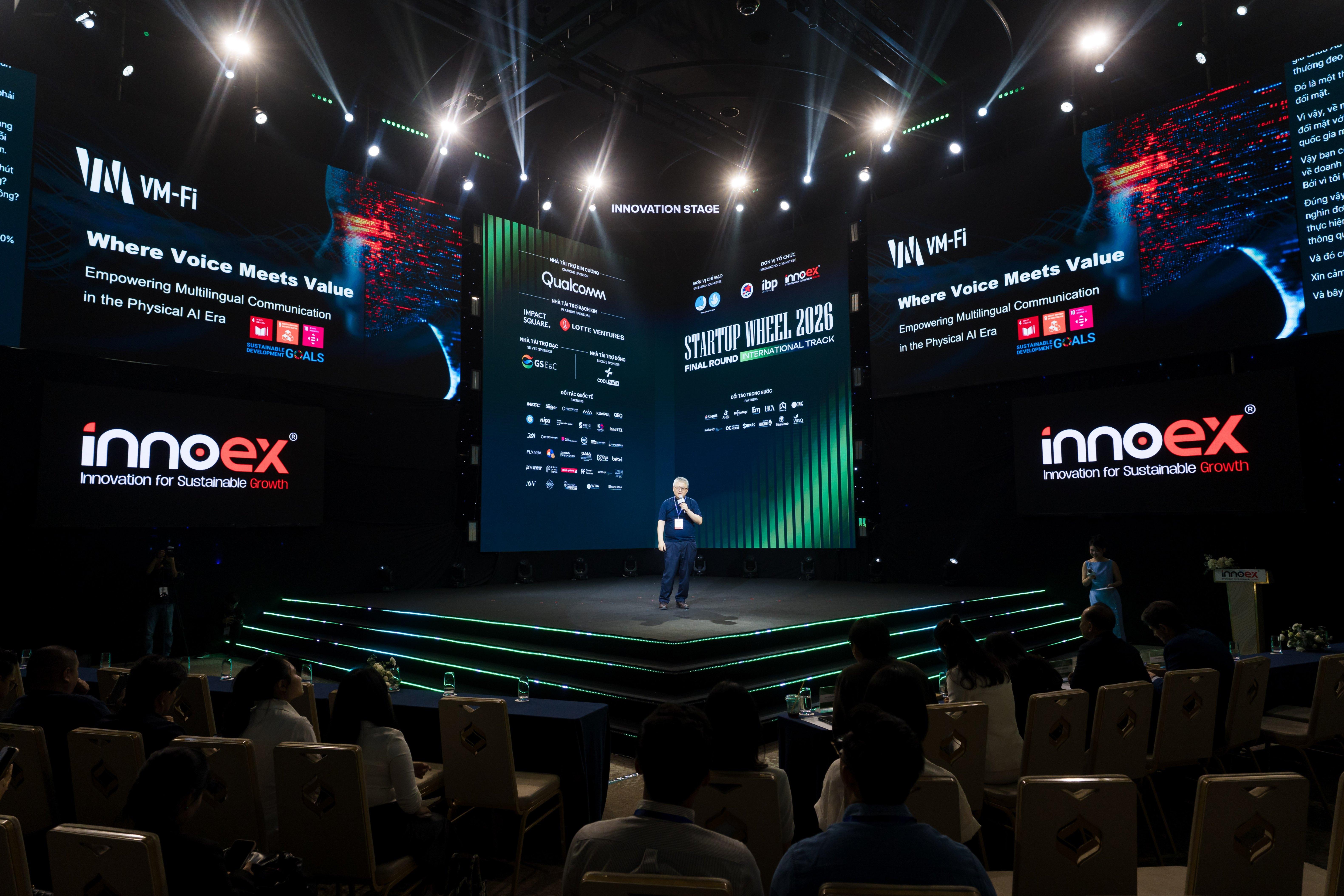
At Startup Wheel 2026 – International Track, VM-Fi secured a place in the Top 5, bringing its story of Voice AI and multilingual communication to an international platform featuring innovative startups from diverse markets.
VM-Fi’s journey at Startup Wheel 2026 continues a broader mission that the company has pursued since its early days: using technology to bridge the gaps between people, languages, and markets.
From its beginnings in Taiwan to its R&D development and strong presence in Japan, VM-Fi is gradually bringing real-time AI voice translation solutions to a growing range of environments worldwide.
For VM-Fi, the value of AI lies in more than its ability to translate a sentence. Its true value lies in helping two people understand each other more quickly, enabling businesses to serve customers more effectively, and making cross-border conversations feel more natural.
From “Every Voice Understood” to “Every Interaction Valued”
VM-Fi’s story can be understood through two layers of value.
The first is “Every Voice Understood”—ensuring that every voice can be understood, regardless of where the speaker comes from or which language they speak.
The second is “Every Interaction Valued”—recognizing that every interaction has the potential to create value.
Together, these principles represent the transition from AI Translation to Voice Intelligence that VM-Fi is pursuing.
While the initial stage focuses on helping people communicate across language barriers, the next stage expands this vision by enabling businesses to gain deeper insights into what is happening within their conversations.
VM-Fi – Top 5, Startup Wheel 2026 International Track – is pursuing a vision in which voice is no longer a barrier, but a source of data, connection, and value in an increasingly multilingual world.